

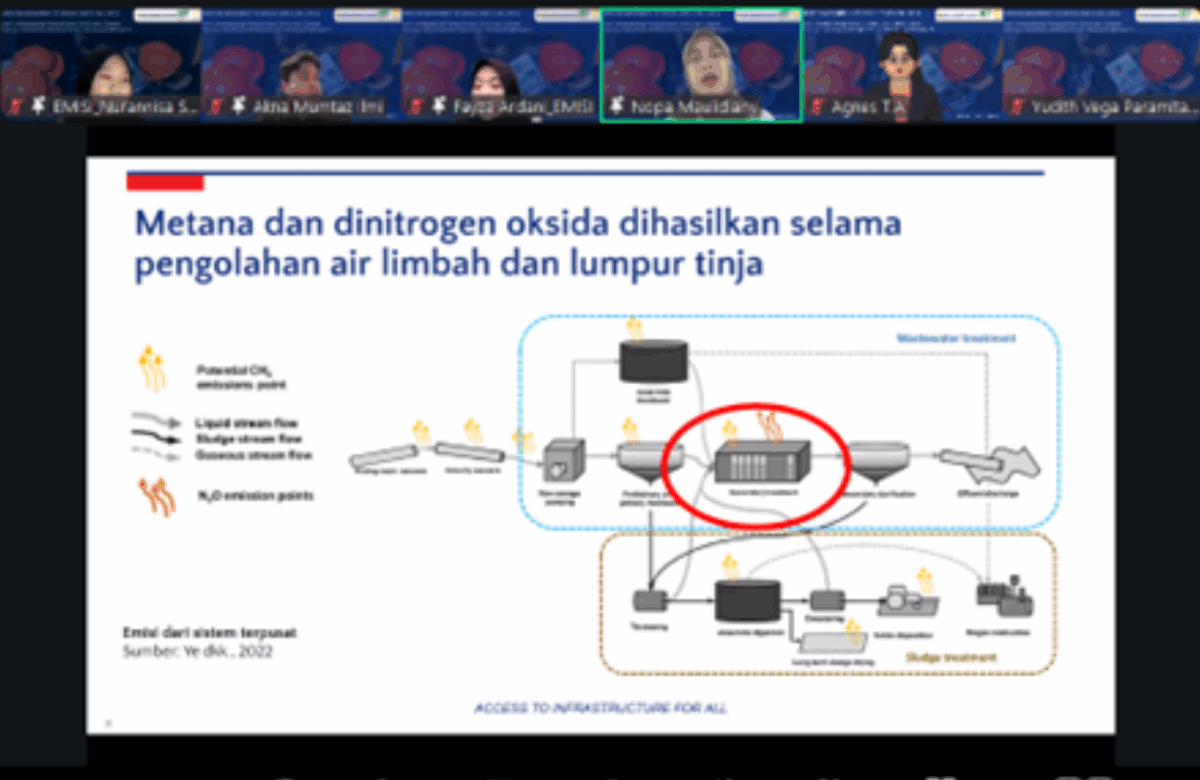
In December 2025, the EMISI team, in collaboration with IATPI (Ikatan Ahli Teknik Penyehatan dan Lingkungan Indonesia/Indonesian Association of Environmental and Sanitary Engineers), held a technical webinar on the measurement of greenhouse gas (GHG) emissions in Indonesia’s sanitation sector. The webinar was initiated as a technical forum to enhance participant’s understanding and practical skills, particularly among IATPI members, PDAM operators, UPTD staff, and local government representatives, in implementing emission measurement methodology at a city/regency level.
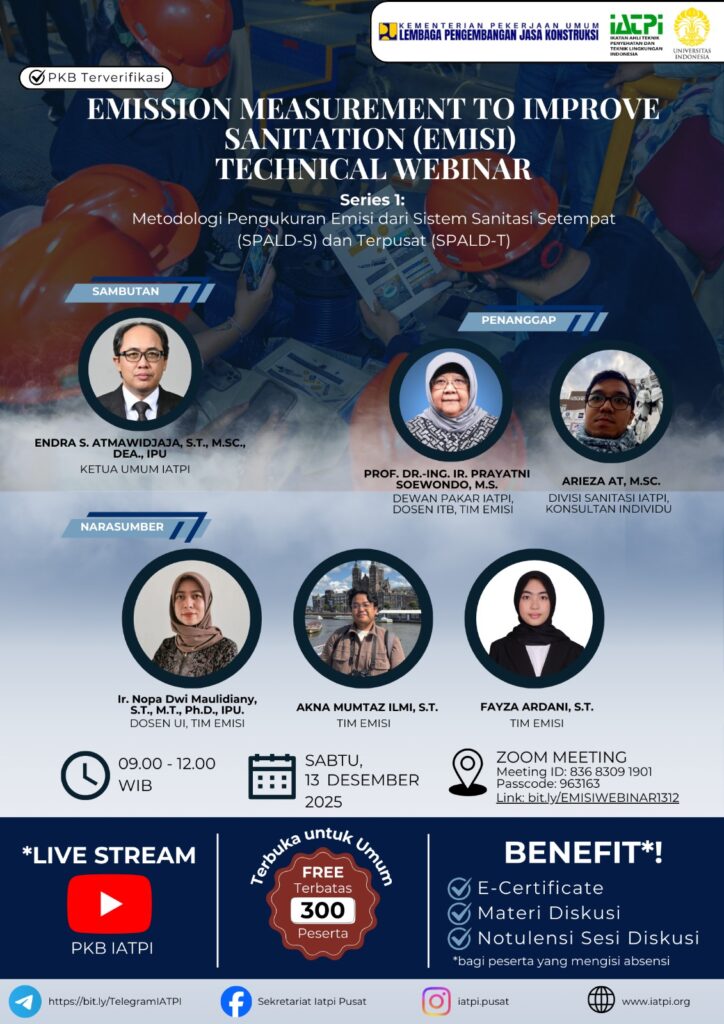
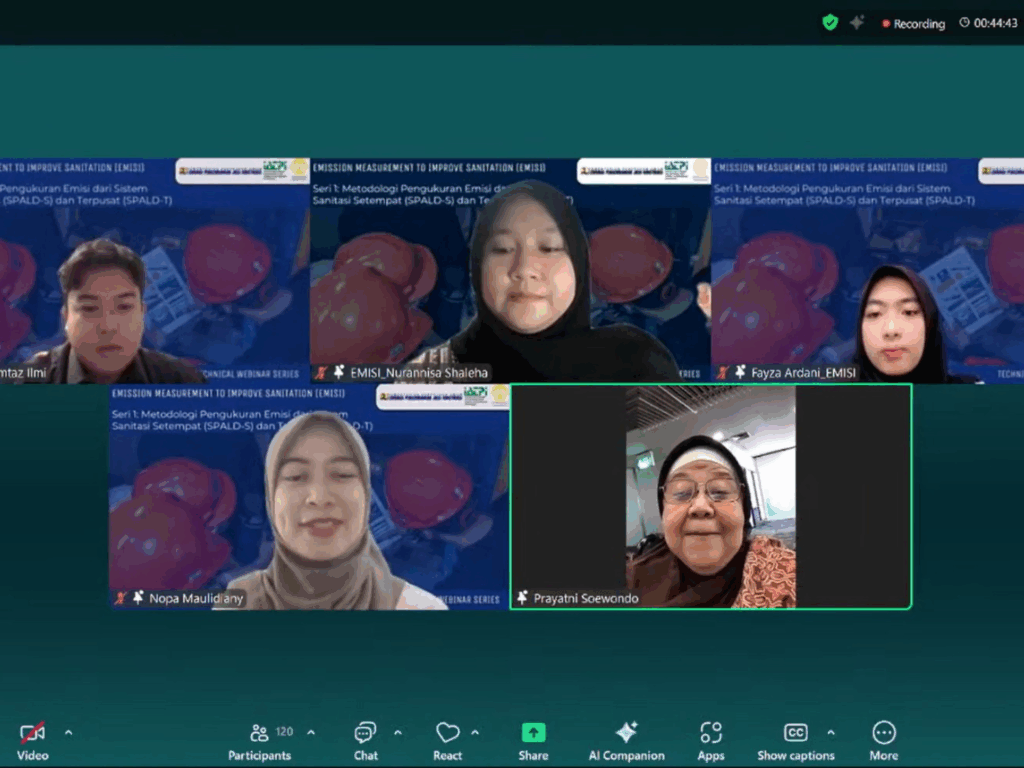
This first webinar series is titled “Methodology for Measuring Sanitation Emissions from On-site (Sistem Sanitasi Setempat) and Centralized (Sistem Sanitasi Terpusat) Systems”. Keynote presentations are done by Ir. Nopa Dwi Maulidiany, S.T., M.T., Ph.D., IPU., Akna Mumtaz Ilmi, S.T., and Fayza Ardani, S.T., who represented the EMISI team. The discussion was deepened by insights from IATPI panelists, including Prof. Dr.-Ing. Ir. Prayatni Soewondo, M.S. (IATPI Advisory Board) and Arieza At, M.Sc. (IATPI Sanitation Division). Their perspectives on sanitation and climate resilience helped explain the core objectives of the EMISI project and made the session more in-depth and dynamic.
With approximately 150 attendees, this webinar has officially verified as a Continuing Professional Development (Pengembangan Keprofesian Berkelanjutan/PKB) activity and recognized by the Construction Services Development Board (Lembaga Pengembangan Jasa Konstruksi/LPJK) under the Ministry of Public Works. This recognition shows that the webinar met national professional competency standards by supporting knowledge, skills, and professional certification. It also reflects the credibility and relevance of the content in strengthening the technical capacity of Indonesia’s sanitation sectors.
Many questions and active discussions were raised by the participants, mainly on natural emissions, unmanaged waste, sampling under unideal field conditions, sustainable implementation of measurement methods, and the result and findings of the EMISI project itself. Some participants also asked whether the project’s results could be used as inputs for broader modelling efforts, such as IPCC methodologies, which indicates awareness of GHG emissions in sanitation systems has become more widespread. However, several questions didn’t fully align with the main theme of the webinar, which focuses on the technical methodology for measuring GHG in sanitation systems. It is assumed that participants find the content was not fully relevant due to different local conditions and limited access to instruments comparable to those used in the EMISI project. This indicates a strong need for separate, direct hands-on training to the local operators to improve understanding and clear practical application.
One interesting input from Dr. Neni Sintawardani, a senior researcher at the National Research and Innovation Agency (Badan Riset dan Inovasi Nasional/BRIN), highlighted the importance of integrating safely managed sanitation and its associated emissions into the formal education system. As an example, she described a study involving high school students in Kiara Condong, where the students conducted a household survey covering 169 households. The survey showed that 55% of households reported having septic tanks. However, it turns out the systems didn’t meet national standards (SNI) as the outlet pathways were unknown. This condition is likely to increase emissions, as the current EMISI findings indicate that non-standardized septic tanks produce higher methane emissions than those meeting the SNI standard. As a result, these systems function as unmanaged waste pathways, making it harder to ensure safely managed sanitation.
Overall, this high engagement reflects strong interest and curiosity on the importance of GHG emission from the sanitation sector and its broader impact. This discussion also provides valuable insights for future capacity building and research, supporting sustainable efforts to manage Indonesia’s problem on GHG emission.
Recording of the forum available below.
 English
  Bahasa Indonesia